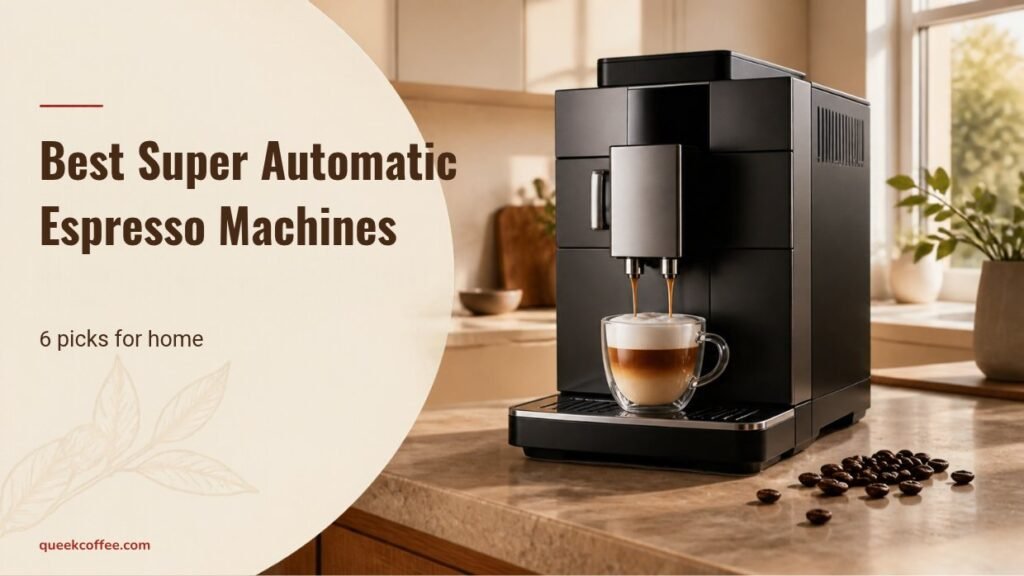
A super-automatic espresso machine grinds the beans, doses and tamps the coffee, brews the shot and drops the used puck into a bin, all from one button. Many models also froth the milk, so a latte takes about as much effort as a drip coffee.
The right one depends less on brand than on how you drink coffee. If you mostly want lattes and cappuccinos, the milk system matters most. If you drink straight espresso, the grinder and brewing control matter more. And whichever you choose, the cleaning routine decides whether you still enjoy it in a year.
How We Chose These Machines
We have not run these machines side by side in our own kitchen. We built the list from the models that leading specialist retailers and reviewers recommend most often, then checked each one against the maker’s specifications for milk system, grinder, water tank, bean hopper and brew group. We also read owner reviews to find complaints that come up again and again.
Every pick below covers a different kind of buyer. Where a machine has a known weakness, it is in the cons.
Quick Picks
- Best value, most proven design: De’Longhi Magnifica ESAM3300
- Best for easy lattes and quick milk cleanup: Philips 4400 Series LatteGo
- Best for switching between two coffees: De’Longhi Rivelia
- Best compact one-touch cappuccino machine: Gaggia Magenta Prestige
- Best for small kitchens on a budget: Gaggia Brera
- Best premium pick: Jura E8
The 6 Best Super Automatic Espresso Machines
1. De’Longhi Magnifica ESAM3300

Adjustable conical burr grinder
Removable brew unit for rinsing
1.8 L (about 60 oz) water tank
250 g (8.8 oz) bean hopper
Manual milk frother
The ESAM3300 has been on sale for years, and that is its strength. It is simple, parts are easy to find, and thousands of owners have rated it on Amazon. You turn a dial for coffee strength and cup size, press a button, and it grinds and brews.
Milk is manual: a frothing wand that you hold the jug under. There is no screen and no drink menu, and it is fairly wide at about 15 inches. If you want one-touch lattes, look at the Philips or Gaggia Magenta instead.
Pros
- Long track record and strong owner ratings
- Brew unit slides out from the front for rinsing
- Large 60 oz water tank
Cons
- Milk frothing is manual
- Dated controls with no display
2. Philips 4400 Series LatteGo

12 hot and iced coffee recipes
LatteGo milk system with no tubes
1.8 L water tank
Ceramic grinder
Adjustable spout height
Philips built the 4400 around its LatteGo milk system: a two-part carafe with no tubes that you rinse under the tap or put in the dishwasher. Philips says it takes under 10 seconds to clean, which matters more than it sounds, because milk systems are where most super-automatics get grubby.
It offers 12 recipes, including iced coffees, and lets you adjust strength, length and milk amount. The carafe is small at 0.26 L, fine for one or two milk drinks, but you will refill it if the whole family wants lattes at once.
Pros
- LatteGo carafe is the easiest milk system here to clean
- Hot and iced recipes from one machine
- Adjustable spout fits tall glasses
Cons
- Small milk carafe for big households
- Owner ratings are more mixed than the Magnifica’s
3. De’Longhi Rivelia

Two removable 250 g bean hoppers (Bean Switch)
Conical burr grinder with 13 settings
3.5-inch color touchscreen
1.4 L water tank
The Rivelia’s party trick is the Bean Switch system: it comes with two removable bean hoppers, so you can keep a decaf or a darker espresso roast ready and swap them in seconds. That solves a real problem, because most super-automatics leave old beans in the grinder when you change coffee.
It has a 3.5-inch color touchscreen and a 13-setting conical burr grinder. The Rivelia is sold both with De’Longhi’s automatic LatteCrema milk system and with a manual frother, so check which version a listing shows before you buy. Its 1.4 L tank is smaller than most here.
Pros
- Two swappable bean hoppers
- Clear color touchscreen
- Narrow footprint, about 9.6 inches wide
Cons
- Smaller water tank than most picks
- Milk system differs between versions
4. Gaggia Magenta Prestige

12 drinks including cappuccino, flat white and latte macchiato
Integrated 0.5 L milk carafe
Ceramic flat burr grinder with 5 settings
1.8 L water tank
About 8.8 inches wide
The Magenta Prestige fits one-touch milk drinks into a narrow body, about 8.8 inches wide. Its 0.5 L milk carafe locks onto the front, froths and pours automatically, then comes off to go back in the fridge.
It offers 12 drinks, from ristretto to flat white and latte macchiato. The trade-off is the grinder: a ceramic flat burr with only 5 settings, so there is less room to fine-tune espresso than on the De’Longhi or Jura machines.
Pros
- One-touch cappuccino and latte macchiato
- Slim enough for small counters
- Large 1.8 L water tank
Cons
- Only 5 grind settings
- Fewer owner reviews than the bigger brands
5. Gaggia Brera

Front-access 1.2 L (about 40 oz) water tank
5-step grinder
250 g bean hopper
Stainless steel Pannarello steam wand
The Brera is a small, no-fuss machine for people who mostly drink espresso or americanos and only sometimes want milk. The 1.2 L water tank and the grounds drawer come out from the front, which helps if your cabinets are low, though beans still go in the top.
Milk is frothed by hand with a Pannarello wand. The grinder has 5 steps, and Gaggia notes you should only change it while it is grinding. The tank is the smallest here, so heavy users will refill it often.
Pros
- Compact, front-loading design
- Simple controls with few things to go wrong
Cons
- Smallest water tank on the list
- Manual milk frothing only
6. Jura E8

Pulse Extraction Process for short coffees
Fine-foam milk frother
1.9 L water tank
280 g bean container
Automatic rinsing and cleaning programs
The E8 is the machine specialist reviewers name most often as the premium choice. Jura’s Pulse Extraction Process pushes water through the coffee in short bursts, which Jura says gives fuller short espressos, and its fine-foam frother handles cappuccino and latte foam well.
Two things to know before you spend this much. The brew unit is not designed to be removed by the owner, so you rely on Jura’s automatic rinsing and cleaning tablets. And the frother needs taking apart and rinsing every day you use milk. Check the listing for stock, because Jura models change often.
Pros
- Excellent espresso and milk foam quality
- Large 1.9 L tank and 280 g bean container
- Built-in rinse and cleaning programs
Cons
- Brew unit is not owner-removable
- The most expensive machine here
Super Automatic Espresso Machine Comparison
| Machine | Milk system | Water tank | Bean hopper | Best for |
|---|---|---|---|---|
| De’Longhi Magnifica ESAM3300 | Manual frother | 1.8 L | 250 g | Value and reliability |
| Philips 4400 LatteGo | Automatic carafe, no tubes | 1.8 L | Not stated | Easy lattes |
| De’Longhi Rivelia | Automatic or manual (by version) | 1.4 L | 2 × 250 g | Two coffees on hand |
| Gaggia Magenta Prestige | Automatic 0.5 L carafe | 1.8 L | 250 g | Small counters |
| Gaggia Brera | Manual Pannarello wand | 1.2 L | 250 g | Budget espresso |
| Jura E8 | Automatic fine-foam frother | 1.9 L | 280 g | Premium quality |
How to Choose a Super Automatic Espresso Machine
Pick the milk system first
Milk decides your daily experience. A manual wand (Magnifica, Brera) is cheaper and easy to rinse, but you froth by hand. An automatic carafe (Philips LatteGo, Gaggia Magenta) makes one-touch lattes. Tube-free designs like LatteGo are the quickest to clean, while systems with tubes need rinsing after every milk drink.
Removable or fixed brew group
The brew group is where the coffee is pressed and brewed. De’Longhi, Philips and Gaggia let you slide it out and rinse it under the tap. Jura keeps it inside the machine and relies on automatic rinses and cleaning tablets. Neither is wrong, but a removable group lets you see that it is clean.
Grinder range and bean choice
More grind settings give you more room to fine-tune espresso. Very oily, dark-roasted beans can clog super-automatic grinders over time, so a medium or medium-dark roast is the safer daily choice. Our espresso beans guide lists good options.
Size and water tank
Measure the space under your cabinets, and check whether the water tank and bean hopper load from the top or the front. A 1.8 L tank is comfortable for two to four daily drinkers; smaller tanks mean refilling every day or two.
Cleaning and running costs
Plan on emptying the grounds bin and drip tray every day or two, rinsing the milk system after each use, and descaling when the machine asks. A water filter reduces scale, but filters and descaler are an ongoing cost. Use the maker’s descaler: some brands warn that vinegar can damage their machines.
Super Automatic vs Semi Automatic Espresso Machines
A semi-automatic machine leaves the grinding, dosing, tamping and milk steaming to you. That gives you full control and the chance to learn latte art, but it takes practice and time every morning. A super-automatic trades some of that control for speed and consistency.
If you enjoy the hands-on side of espresso, compare our espresso machines with grinders or manual espresso machines. If you want great coffee with minimal effort, a super-automatic is the better fit. Brand-specific picks are in our De’Longhi and Gaggia guides, and machines for teams are in our office coffee machine guide.
Frequently Asked Questions
Are super automatic espresso machines worth it?
They are worth it if you drink espresso-based coffee every day and value speed over hands-on control. Over time, whole beans cost much less per cup than café drinks or pods, which offsets the higher purchase price.
What is the difference between an automatic and a super automatic espresso machine?
An automatic machine controls the water and shot volume, but you still grind, dose and tamp the coffee. A super-automatic does all of it, from grinding beans to dumping the used puck, and many models also froth milk.
Do super-automatic machines make real espresso?
Yes. They brew under pressure through freshly ground coffee, which is how espresso is made. They give you less control over dose and extraction than a semi-automatic, so the result is consistent rather than finely tuned.
Can I use oily dark roast beans in a super automatic machine?
It is best to avoid very oily beans. The oils can build up in the grinder and chute and cause clogs over time. Medium to medium-dark roasts with a dry surface work best.
How often should I descale a super automatic espresso machine?
Descale whenever the machine’s alert tells you to, which depends on your water hardness and how much coffee you make. Using the maker’s water filter, where available, means descaling less often.
Which Super Automatic Espresso Machine Should You Buy?
For most homes that want proven reliability at a fair price, the De’Longhi Magnifica ESAM3300 is the safe choice, as long as you are happy to froth milk by hand. If one-touch lattes and quick cleanup matter more, the Philips 4400 LatteGo is the better fit.
Choose the Rivelia if you switch between two coffees, the Gaggia Magenta Prestige for one-touch milk drinks on a small counter, the Brera for simple espresso on a budget, and the Jura E8 if you want premium quality and don’t mind the price. More coffee gear guides are on our coffee gear page.

MD Azizul Hakim is a content creator and the co-founder of Queek Coffee. He has been writing content and reviews for many years and loves to brew coffee and serve it to his colleagues.


